
04 May, 2026

At some point, almost every small business asks the same question: should we focus on SEO or content marketing? It usually comes after a slow month, a puzzling analytics report, or someone confidently claiming one has made the other obsolete. Here is the direct answer. SEO without content has nothing to rank. Content without SEO has no way to be found. They are not competing strategies. They solve different problems, and they work best when used together.
Understanding where SEO ends and content marketing begins helps you spend time on the right activity at the right moment, and avoid the most common mistake SMBs make with both.
Table of Contents
- What SEO content does for your rankings
- What content marketing does that rankings alone cannot
- The real difference between SEO content and content marketing
- When it makes sense to prioritize one first
- How to combine SEO and content marketing for sustainable results
- How rankingCoach supports your SEO and content marketing
- Frequently Asked Questions
What SEO content does for your rankings
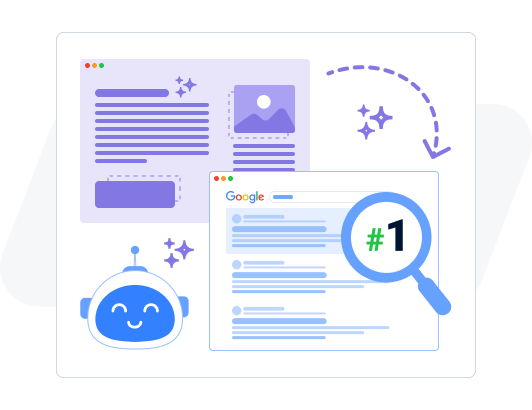
.gif?width=559&height=430&name=content_for_SEO%20(1).gif) SEO content exists to rank. Its job is to match a user's search query closely enough that Google puts your page in the results. That means targeting the right keywords, covering the topic the searcher actually wants, and making sure Google can crawl and index the page in the first place.
SEO content exists to rank. Its job is to match a user's search query closely enough that Google puts your page in the results. That means targeting the right keywords, covering the topic the searcher actually wants, and making sure Google can crawl and index the page in the first place.
What SEO content does not do on its own is build a relationship. A visitor who finds your page, gets a quick answer, and leaves may never come back. Pages optimized purely for visibility, with no real value for the reader, are increasingly at risk as Google places more weight on engagement signals like time on page and bounce rate.
What content marketing does that rankings alone cannot
Content marketing is written to connect. The goal is not just a click from Google, but trust. A hotel writing a guide to the best things to do in their city. A bakery sharing recipes. A plumber explaining what causes blocked pipes. None of these feel like a sales pitch, but all of them build familiarity with a brand before a purchase decision is made.
The problem is discoverability. You can write the most helpful guide in your industry and still see almost no traffic. Without SEO, content depends on paid promotion, social shares, or word of mouth to reach people. That does not scale sustainably for most small businesses.
The real difference between SEO content and content marketing
The simplest way to see the distinction:
- SEO content targets specific search queries to bring people to your site. Content marketing gives them a reason to stay, return, and eventually buy.
- SEO is measured through rankings, organic traffic, and click-through rates. Content marketing is measured through engagement, time on page, and conversions.
- SEO starts with what people are already searching for. Content marketing can also build interest around topics before that demand fully exists.
One gets people to your site. The other builds the relationship that turns visits into sales.
When it makes sense to prioritize one first
Not every business starts from the same position. Here is a simple way to think about sequencing.
- New site or no prior SEO: Start with SEO. Technical setup, keyword research, and basic on-page optimization give Google what it needs to index and rank your pages. Without this foundation, even strong content will struggle to reach anyone through search.
- Existing traffic but low conversions: Shift focus to content marketing. The issue here is usually not visibility but relevance and trust. Better, more useful content improves engagement and gives visitors a reason to return.
- Tight budget: Write content that does both jobs. Find keyword-driven topics your customers are already searching for and write content that genuinely helps with those questions. Fewer pages, well-optimized and high quality, outperform a high volume of thin content every time.
The point is sequencing, not choosing sides permanently. SEO builds the foundation. Content marketing builds what runs on top of it.
How to combine SEO and content marketing for sustainable results
The goal is not to manage two separate strategies. It is to run one integrated approach where keyword research informs content planning, and content quality feeds SEO performance.
- Start with keyword research. Find topics your customers are already searching for. These become your content starting points, not guesswork.
- Write to fully answer the question. Google rewards completeness. Readers reward it with time on page and return visits.
- Optimize every piece. Keyword in the title, H1, URL, and naturally throughout the body.
- Link related pieces to each other. Internal links help Google understand your site structure and keep readers exploring.
- Track both traffic and engagement. High traffic with a high bounce rate means the content needs work. Strong engagement with low traffic means the SEO does.
- Refresh top performers regularly. Updating existing content with new information and improved keyword alignment often drives more results than publishing something new.
The payoff is compounding visibility. Pages that rank well bring readers. Readers who find value share and link. More links improve rankings further. That cycle only starts when SEO and content marketing are working as one.
How rankingCoach Supports Your SEO and Content Marketing
rankingCoach gives SMBs the tools to run both without needing an agency. The AI Keyword Builder shows you what your potential customers are searching for, so your content starts with real demand behind it. The AI Content Optimizer guides you through optimizing each piece for the right keywords, covering on-page requirements step by step.
The AI Visibility feature shows you how your business appears in AI-generated answers from tools like ChatGPT, Perplexity, and Gemini. You can see how you compare against competitors in AI search, detect gaps in visibility and data accuracy, and get clear next steps to improve your presence before those gaps cost you customers.
Frequently Asked Questions
What is the difference between SEO and content marketing?
SEO focuses on making pages rank in search results for specific queries. Content marketing focuses on building trust through useful, relevant material, though it works best when it is also optimized for search.
Can content marketing replace SEO?
No. Content marketing improves engagement and brand trust, but without SEO it has limited reach. SEO ensures your content is discoverable when people search for topics related to your business.
When should a small business prioritize SEO over content marketing?
If your site is new or has never been properly optimized, SEO should come first. Once the technical foundation is in place and pages are ranking, content marketing becomes the lever for improving engagement and conversions.
Does content marketing help with SEO rankings?
Yes. Useful content earns links from other websites, which is one of the strongest ranking signals. It also increases time on page, which signals to Google that the content deserves a higher position.

